
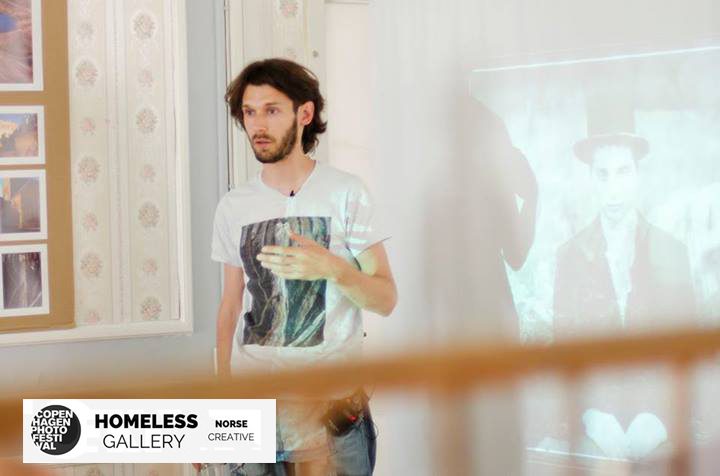
“The place where creativity exists”. A talk given at the photo festival in Copenhagen. June 2014
During talks like this, or classes on the course, there is always a feeling that authors keep saying words everyone has long known. About photography and about creativity in general. Words everyone has known for a long time. So why is there still such a big difference between authors and those who want to become authors? After all, they all have the necessary knowledge not only about equipment and technology, but even about each other?
And now I will go on saying words that everyone knows. They are obvious and often mentioned. But I will try to show that the problem lies precisely in the words, or rather in our feeling that we know them exactly.
Before trying to describe the subject, I would like to excuse myself in advance. You have to understand that an attempt to describe non-verbal processes in verbal language is doomed to fail unless the person describing them is a writer of a high level. So please take the allegorical nature of my language as an attempt to convey meaning through images everyone can understand.
It is also necessary to define the limits of the notion of “creativity”. In this text the notion will mean the act of self-expression or the result of the act of self-expression.
__
Teaching in a creative field is interesting because, if the teacher is not only a theorist but also a practitioner with their own creative work, then, while being a teacher, they are also the subject of study. Like a researcher who experiments on themselves.
It is a constant change of position from the one who does to the one who observes the one who does. Observing, analysing and trying to explain what is happening. Constantly crossing the border between two spaces: the territory of authors and the territory of those who want to be authors. Regular business trips from one world to the other, in both directions.
Territory, terrain is a very convenient allegory for conveying the essence: the creative space is a separate place, located at a completely different abstract-geographical point than a person’s everyday and social activity.
A more precise name for this kind of territory and terrain is a “state”.
A state is a characteristic every person necessarily has. Just like temperature, height, colour, shape, posture … A person cannot be without shape, colour or temperature, and likewise cannot be in no state at all. Of the endless number of states a person can be in, here we are interested in the “creative state”. A separate space where thought, feeling and action dwell. Imagine that a state is a room or a field with its own smell, temperature, wind speed, air density. Like another country, an island, a private study with its own order, legislation, climate, laws of gravity, time zone, currency…
The creative state is a space of heightened sensitivity.
The main problem is the attempt to equate the laws of the creative space with the laws of another space, most often the everyday or the social one. And this although everyone understands that these spaces differ in their goals and tasks.
Trying to live in one country by the rules of another, or to create universal rules for both, is utopian – unless, of course, you want to destroy one or both of them (as the modern globalisation of cultures, already recognised as a mistake, does). And it is just as important to understand that it is impossible to be in two spaces at once, however close they may seem to be, inside one person. They are two different locations of thought, feeling and action, and each has its own system of values. That is why a conversation between someone in the creative space and someone in the everyday or social space often looks like a dialogue between a believer and an atheist – people who are, at the same moment, in different systems, in different worlds.
The main difference between the creative space and the everyday and social ones is the irrationality of all its processes. The absence of a criterion of truth, correctness and usefulness. It is only a feeling, an opinion or a private realisation. A process or a result free from any obligatory functional use.
The first way of unconsciously seizing the creative space is the attempt to live in it by the rules of the everyday space.
The charter of today’s everyday space is rationality and science. Every action is performed to achieve some goal; success in achieving the goal largely depends on the strategic plan and the amount of theoretical knowledge – the more complex the knowledge, the more it is trusted.
The everyday rationalisation of everything around has also rationalised human thinking, which now lives in a world of total terminological description. In other words, in today’s world there should not and cannot be a process that cannot be expressed in words and numbers. And even less should it happen that a person doing something cannot describe what they are doing and for what purpose.
The proof is the wish to follow rules even where there are none. And the most frequent questions: “With what does this or that author make their works?”, “What do I need to do to make the same?”, “What is the author’s secret?”.
Ask “creative authors” about this, and the answer will not satisfy you. All you will hear is a long silence and a painful attempt to assemble an unreflected process into a meaningful description. Or the standard phrase: “I do the same as you, and it turns out the way it turns out.” Perhaps even with a description of the process, in which there will indeed be nothing new. As a rule, the person asking is unhappy with such an answer. They will think the answer cannot be that simple, cannot lack a considerable amount of new functional information, and so will decide the author does not want to share their secret knowledge. Because the person asking is convinced that only secret information can separate them from this author’s level, and that the author cannot fail to have this knowledge.
Nevertheless, authors who answer “I do the same as everyone” are absolutely sincere and truthful. But the indignation of the one asking – “I do exactly the same actions, but the result is not the same” – is also truthful. So the difference is not in the physical accuracy of repeating the action.
Authors forget to add, or do not realise themselves, that although they do the same as the person asking, they do it in another space, with a radically different ecosystem. The laws of different spaces are just as different and do not work outside their own space. Accordingly, the same actions performed in different spaces have different results.
The creative space, in turn, being an irrational world, has no connection with rationality, such as a goal and its achievement. By a goal we mean a conscious choice of the end result.
The basis of the processes is not a goal but a reason. A reason, in turn, is a cause for action, not a desired result. The action is done not “with the aim” but “for a reason”, not “in order to…” but “because”. If we do not bring in a psychological analysis of the components of the reasons, we can stop at the general reason – “because I want to perform the action”. This is the main justification of the action, which in the rational everyday world sounds like a rebellion against the goal. A goal can appear here only as “the goal of satisfying a wish”.
Therefore, to the question of how the author did something, the answer will be: in a way that satisfies their wish. To the question of how I, a photographer of black-and-white photographs, learned to make colour ones, I can only answer: “I wanted colour.” In the everyday world this phrase sounds as banal as buying happiness quickly in the nearest shop. But since everything happens in the creative space, an environment of heightened sensitivity, it is a heightened, sharpened wish for a specific colour. Translated into the language of the everyday world, this degree of wanting is usually called “a need for something very specifically defined” or even “a basic need”. And that is not the same as the phrase “now I want my photographs to be in colour”. A more accurate translation would be “I came to need a specific character of colour very badly”.
The next question usually is: what matters is not only having colour but also how to combine it harmoniously. The answer is just as simple – you need to be a person who needs harmony of colour. The reverse question: how can an author make black-and-white photographs such that they do not need colour? The answer is accordingly: be in need of the absence of additional colour. And so on.
Of course, besides the wish you also need skill. But skill consists of 10% technical and informational knowledge, 45% the degree of immersion in thought and feeling, and 45% action.
When a person looks at an author’s work and likes, for example, the geometry of its forms, they say: “The author likes geometry.” Or: “The author used geometry here in order to …”. And this is a more than superficial statement. At the moment of creation the author does not so much like geometry as need it, and at that moment becomes geometry themselves. And that is a different reason and a different level of sensitivity. This degree of wanting, the depth of feeling and thought turned into a need, is what shapes the character of the action and the result.
It is important not to forget that feelings are not a binary computer system with radically opposite states, but an endless multitude of intermediate shades too.
The only truly important question remains – how do you get into the creative space? And so, how do you want something to the necessary degree? Remember, this does not happen “in order to…”, it happens “because”.
The second way to destroy the creative space is to enter it with the laws of the social space.
The laws of the social world: defining your own status in society; accepting your original status or trying to redistribute status for some purpose – superiority or equality; keeping up with public events.
A person as a social object has several basic models of behaviour: to be with everyone; to be against everyone; to be with anyone but them; to be who you are, come what may. Interestingly, the last model is the most antisocial in the social world, and in the creative world it is the only one that makes sense.
So the answer to the question of how to learn to make the same work as another author would be: get into the state, or create exactly the same state, in which the same thought, feeling and action will dwell. And in the space of expressing your own wish this is completely meaningless.
The very wish to repeat someone’s work, or the wish to differ radically from others, is an entirely social goal. Adapting your own behaviour to gain social status. Proving to yourself and others that I can do it too, wanting the same popularity, respect or rejection as the original, or trying to influence the opinion and behaviour of society. It is an attempt to take the place of a feeling, thought and action that are not your own, for the sake of a social goal.
But in the creative world everything rests not only on the degree of feeling but also on the importance of the feeling being your own. Which means there is no room for goals and conquering status, or for public interests. The only things that can connect a creative act with society are the occasion for immersing yourself in the creative state and the subject of the creative work.
A surge of creative activity can be seen in times of great social change – political revolutions, people’s private relationships. All this is usually called emotional experience. Positivity and negativity affect the subject and the form of presentation, and the depth of experience affects the richness of the description.
A creative work is not an informational discovery and not a social influence. It is an invitation and a road into the space of the author’s feelings and thoughts. And the better it describes the space, the deeper the guest will go into it. They cannot pass it by, except by going right through it.
From all this one might conclude that every space except the creative one is being criticised, and that a person can and should live in only one of the described spaces. That is, of course, not so. It is impossible and unnecessary. The everyday and social spaces are an unavoidable and no less useful and interesting part of life. And while remaining physically the same and not changing physical place, a person is able to move from one state to another. This affects not only the subject of attention but also the character and content of their thoughts, feelings and actions regarding one subject, object, process…
Thoughts and feelings that cross “legally” from other spaces must leave goods prohibited for import at the border: the rational pursuit of a goal, the wish for social reward. In turn, when leaving the creative space, so as not to be unfounded, they would do well to acquire the goals and areas of application they lack.
Also, being in one of the states allows you to think and feel about any other state. As if you were watching international TV channels. Whether news, science and history, culture and philosophy, or teleshopping.
So this analysis of the creative space was made alternately from the everyday and the social ones. But whoever chooses to live in the creative space as well should remember, or at least try to understand, which space they are in at a given moment and from the window of which space they are watching which. Otherwise one of them, or both, will very likely suffer.
For better or worse, in today’s world the everyday and social spaces are more resistant to attack from outside, while the creative space is more vulnerable.
Unfortunately, because social values have penetrated the creative space, and with the mass slogan “be an individual, be original”, people believe less and less in the worth of their own inner world in the creative space.
And it is precisely the existence of this world, its strength, depth, detail and richness that make creativity existing, strong, authorial, deep, detailed, rich…
__
Creative classes and exercises are a travel agency – and for some an emigration bureau – for moving from the everyday space to the creative one, and for protecting it. Moving in the opposite direction is handled perfectly well by theoretical education, capitalist, communist and many other systems, everyday life, the social environment …
Dmitry Bulkin
2014. Copenhagen